The World Needs Libraries: Looking at Libraries in Developing Countries and the Use of Mobile Devices in Classrooms
"The only thing that you absolutely have to know, is the location of the library." - Albert Einstein
How are libraries in developing countries supporting their patrons? What types of resources could be best utilized in these environments? Do mobile devices play a role in these libraries? How can they assist their patrons in accessing more up to date information? Do libraries only need books? Should libraries in developing nations rely on donations and weeded books from developed nations?
So, what are the answers? Libraries in developing countries do more than just provide books for students. For example, libraries in developing countries help farmers to connect to new markets, help entrepreneurs find capital to start businesses, and help health workers access research to provide up to date care to patients (Hamilton).
From my research I have found several organizations that help support libraries and their patron's needs in developing countries. In particular, I was drawn to the Electronic Information for Libraries (EIFL) website that supports the access of technology information in developing countries. EIFL believes that everyone should have access to knowledge and information. They focus on building libraries' ICT skills through training of librarians and developing tools and resources.
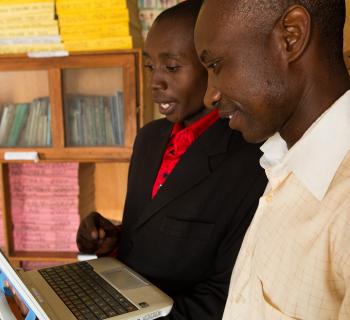 |
Librarians are teaching farmers new skills in Bwera Information Centre and Community Library in Kasese District in Western Uganda.
|
Furthermore, EIFL introduced tablets into libraries to help with student's education. They teamed up with eLimu, which creates digital content for schools in fun formats like animations, video and quizzes. eLimu pre-loaded the tablets with educational material, and taught the librarians how to integrate the tablets and the content into a learning program, and how to teach the children to use the tablets (EIFL, http://www.eifl.net/programme/public-library-innovation-programme/public-libraries-contributing-education).
 |
| School students use tablets pre-loaded with educational content in fun formats in Kibera Public Library. |
It is uplifting to know that developing countries are gaining in information literacy and have at least some access to 21st Century Learning. However, there is always more that can be done, especially in more rural areas of the world. The following is a list of Library Projects that are helping developing countries gain even more access to information.
Library Projects in Developing Nations:
- Books for Africa
- International Book Project
- Seeds of Learning
- Camel Book Drive
- Books for the Barrios
- African Library Project
Final Thoughts: All libraries should have access to the most up to date information possible. Thus, should libraries in developing countries rely on donations and weeded books from developed nations? Not all the time. Libraries in developing countries deserve to have books that provide current information. By relying on weeded books, these libraries become limited in current content. However with limited budgets, it is always nice to get donations. Therefore, libraries in developing countries should not completely rely on donations and weeded books alone, but also have access to online information and newer content books as well.

References:
Electronic Information for Libraries (EIFL). (2015, October 28) [Retrieved from: http://www.eifl.net/]
Hamilton, Stuart. (2013, March 12). Stamping out poverty as well as books? How libraries can support development. Guardian News and Media. [Retrieved from: http://www.theguardian.com/global-development-professionals-network/2013/mar/12/libraries-power-global-development].
Photo: Librarians are teaching farmers new skills in Bwera Information Centre and Community Library in Kasese District in Western Uganda. [Retrieved from:
http://www.eifl.net/programme/public-library-innovation-programme/we-advocate-libraries-advance-development]Photo: School students use tablets pre-loaded with educational content in fun formats in Kibera Public Library. Photo credit Elaisha Stokes [Retrieved from: http://www.eifl.net/programme/public-library-innovation-programme/public-libraries-contributing-education]
Room to Read. (2013, April 30). Room to Read | Our Work. Retrieved from: https://www.youtube.com/watch?v=JpyeZ6BcslA
Winthrop, Rebecca, & Smith, Marshall S. (January 2012). A New Face of Education: Bringing technology into the classroom in the Developing World. Brooke Shearer Working Paper.